

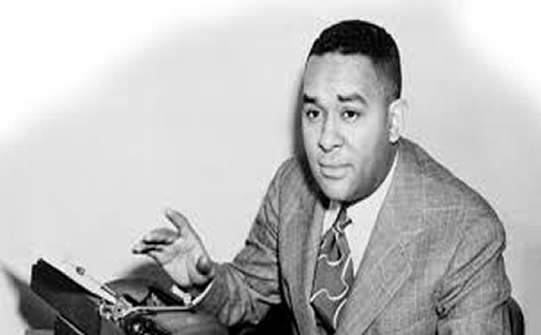
Biography of the Author of Native Son

Richard Wright was born in Mississippi in 1908. Mississippi is known to be the most African-American settlement that suffered much of the black subjugation. He was raised by his mother and grandmother because his father abandoned the family. His family moved from place to place, just like every other poor family then. They moved from Mississippi to Arkansas to Tennessee. In his class, he graduated valedictorian in his class. When he moved to Chicago, he engaged in menial jobs to support himself. It was there in the 1930s that he joined the Reed club, a communist group that later sponsored his writing of several stories and essays. He moved to New York in 1937 and became the editor of the communist Party Publication, known as the Daily Worker. His 1938’s short stories, Uncle Tom’s Children, which is his first work borders more on the concept of the African-American men who put themselves in a lower position to white people.
More details from Wikipedia
“Richard Nathaniel Wright was born on September 4, 1908, at Rucker’s Plantation, between the train town of Roxie and the larger river city of Natchez, Mississippi.[2] His memoir, Black Boy, covers the interval in his life from 1912 until May 1936.[3] He was the son of Nathan Wright (c.1880-c. 1940) and Ella (Wilson) (b.1884 Mississippi[4]– d.Jan 13, 1959 Chicago, Illinois).[5] His parents were born free after the Civil War; both sets of his grandparents had been born into slavery and freed as a result of the war. Each of his grandfathers had taken part in the US Civil War and gained freedom through service: his paternal grandfather Nathan Wright (1842–1904) had served in the 28th United States Colored Troops; his maternal grandfather Richard Wilson (1847–1921) escaped from slavery in the South to serve in the US Navy as a Landsman in April 1865.
Richard’s father left the family when the boy was six years old, and he did not see him for 25 years. In 1916 his mother Ella moved with Richard and his younger brother to live with her sister Maggie (Wilson) and her husband Silas Hoskins (born 1882) in Elaine, Arkansas. This was also in the area of the Mississippi Delta and former cotton plantations. The Wrights were forced to flee after Silas Hoskins “disappeared,” reportedly killed by a white man who coveted his successful saloon business.[6] After his mother became incapacitated by a stroke, Richard was separated from his younger brother and lived briefly with another uncle. At the age of 12, he had not yet had a single complete year of schooling. Soon Richard and his mother moved to the home of his maternal grandmother in the state capital, Jackson, Mississippi, where he lived from early 1920 until late 1925. There he was finally able to attend school regularly. After a year, at the age of 13 he entered the Jim Hill public school, where he was promoted to sixth grade after only two weeks.[7] In his grandparents’ pious, Seventh-Day Adventist household, Richard felt stifled by his aunt and grandmother, who tried to force him to pray so that he might find God. He later threatened to leave home because his Grandmother Wilson refused to permit him to work on Saturdays, the Adventist Sabbath. This early strife with his aunt and grandmother left him with a permanent, uncompromising hostility toward religious solutions to everyday problems.
At the age of 15, while in eighth grade, Wright published his first story, “The Voodoo of Hell’s Half-Acre”, in the local Black newspaper Southern Register. No copies survive.[2] He described the story as about a villain who sought a widow’s home, in Chapter 7 of Black Boy.[8]
After excelling in grade school and junior high, in 1923, Wright earned the position of class valedictorian of Smith Robertson junior high school.[2] He was assigned to write a paper to be delivered at graduation in a public auditorium. Later, he was called to the principal’s office, where the principal gave him a prepared speech to present in place of his own. Richard challenged the principal, saying “…the people are coming to hear the students, and I won’t make a speech that you’ve written.”[9] The principal threatened him, suggesting that Richard might not be allowed to graduate if he persisted, despite having passed all the examinations. He also tried to entice Richard with an opportunity to become a teacher. Determined not to be called an Uncle Tom, Richard refused to deliver the principal’s address, written to avoid offending the white school district officials. The principal put pressure on one of Richard’s uncles to speak to the boy and get him to change his mind, but Richard continued to be adamant about presenting his own speech, and refused to let his uncle edit it. Despite pressure even from his classmates, Richard delivered his speech as he had planned.
In September that year, Wright registered for mathematics, English, and history courses at the new Lanier High School, constructed for black students in Jackson. (The state had segregated schools under its Jim Crow laws.) He had to stop attending classes after a few weeks of irregular attendance because he needed to earn money for family expenses.[10]
The next year, at the age of 17, Wright moved on his own to Memphis, Tennessee, in November 1925. He planned to have his mother come to live with him when he could support her. In 1926, his mother and younger brother rejoined him. Shortly thereafter, Richard resolved to leave the Jim Crow South and go to Chicago.[11] His family joined the Great Migration, when tens of thousands of blacks left the South to seek opportunities in the more economically prosperous northern and mid-western industrial cities.
Wright’s childhood in Mississippi, as well as in Memphis, Tennessee, and Elaine, Arkansas, shaped his lasting impressions of American racism.[12]
“
 Litionary