

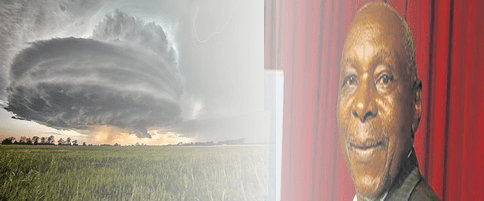
In other not to lose sight of meaning, we will interpret this poem in two phases: the way it appears and what it might mean. Why so? In as much as the poem seems to be about African weather, there are insinuations of colonial invasion as well as other political undertones.
Hence, for gross intelligibility, it becomes pertinent to unleash meaningful interpretation on the two phases so that no meaning will be lost and to prepare us for questions that may arise from the poem.
The Poem
From the west
Clouds come hurrying with the wind
Turning sharply
Here and there
Like a plague of locusts
Whirling,
Tossing up things on its tail
Like a madman chasing nothing.
Pregnant clouds
Ride stately on its back,
Gathering to perch on hills
Like sinister dark wings;
The wind whistles by
And trees bend to let it pass.
In the village
Screams of delighted children,
Toss and turn
In the din of the whirling wind,
Women,
Babies clinging on their backs
Dart about
In and out
Madly;
The wind whistles by
Whilst trees bend to let it pass.
Clothes wave like tattered flags
Flying off
To expose dangling breasts
As jagged blinding flashes
Rumble, tremble and crack
Amidst the smell of fired smoke
And the pelting march of the storm.
Definitions
- Cloud: A visible mass of water droplets suspended in the air. Anything that makes things foggy or gloomy… obscure from sight.
- Plague: A wide spread affliction, calamity or destructive influx, especially when seen as divine retribution (punishment). A great nuisance; whatever greatly irritates.
- Whirl: To rotate, revolve, spin, or turn rapidly
- Perch(intransitive): To rest on something
- Sinister: Evil, seeming to be evil
- Din: a loud noise
- Clinging: to hold very tightly, as to not fall off.
- Dark: A sudden turn or fast movement
- Whilst(while): At the same time
- Jaggered: Something that is rough and harmful
- Pelt(ing): To beat or hit, especially repeatedly. To rain or hail heavily
Analysis
Stanza One
The poem opens with the first line specifying where the wind is coming from. The wind in question, which is also accompanied by the cloud, is portrayed to have speed and strength:
“Clouds come hurrying with the wind
Turning
Sharply
Here and there”
In this stanza, the wind is depicted as being destructive (line 6):
“Like plague of locust”
A plague of locust inflicts pain and destruction wherever it visits. Take Egypt in the days of Moses for example.
Line 9 tells the reader that the wind is not only destructive, but it has no specific direction or destination.
“Like a mad man chasing nothing”
A mad man has no focus in thought, dangerous to anyone around and moves often without a specific abode.
Stanza two
What can one make of a “pregnant cloud”? The word, “pregnant,” added to the word, “cloud,” informs the reader that cloud carries more things that are yet to be unleashed. It moves in line (stately) with the wind and poses a threat (dark sinister winds).
“Gathering to perch on hills
Like Dark sinister winds”
The last two lines of the stanza tells us that the wind make noise and forcefully subdue the trees.
“The wind whistles by
And trees bend to let it pass”
Stanza three
In this stanza, the image of a village with children and women is created in the mind of the reader. Children appear to be screaming in joy, probably in anticipation of a rainfall or maybe the joy is triggered by the way the wind tosses things.
Nonetheless, in line 21, the children cling to the back of women (their mothers). Looking at the meaning of the word, cling, and the context of usage, it seems that the children are equally afraid.
As the sound of the wind roars and its strength forcing the trees to bend, clothes fly and fall from ropes and even from the women’s body.
“Clothes wave like tattered flags
Flying off
To expose dangling breasts”
For better understanding, try to imagine those windy period when the wind fling clothes off from the ropes and hanging places.
Then, from line 30 to the end, it seems the pregnant cloud has delivered its offspring as lightening and thunderbolts strike.
“As jaggered blinding flashes
Rumble, tremble and crack
Amidst the smell of fired smoke
And the pelting march of the storm”
Second Analysis
Stanza one
“From the west came the wind,” would refer to Europeans who came from the West and are often referred to as the Westerners. The force of the wind depicts how they forcefully invaded Africa, tossing and turning up-side-down every African cultural value.
In this line of interpretation, it seems like a pestilence inflicted on the land. They authoritatively roar (whistle – this might mean firing of guns) and the Africans out of fear bow to them and bend theirs ways to allow for the adoption of western culture.
“Like a mad man chasing nothing”
This could mean that they seem not to want anything in particular, but everything and to conquer all. This kind of dominance is evident in the French assimilation principle.
Stanza two
“Pregnant Cloud”
The first line of the stanza, shows that Africans have no idea about what will follow the Westerners’ visit, but, they know that there is more to the fierce visit of subjugation, and whatever it is that they have in mind hidden from Africans, it falls in line with fighting, conquering and subjugation of Africans. The line below shows this.
“Ride stately on its back
Gathering to perch on hills”
There is more to the above two lines: what is it that the colonial masters secretly comes with and goes on to stay in the high places (kings, people of influence or something similar).
Stanza three
This stanza tells us that once the white with their gun fire and war enter a village, the children are delighted to see them, but on seeing the destruction they inflict, the children clings to their mothers. The children could mean youths who are always the first to embrace change, and the women represents the elders.
However, they start taking what they came for, causing move havoc on the land.


Great insight into Rubadiri’s world of thought.
LikeLike
It was a really good story. I love how the pregnant clouds ride on it’s back to gather the perch on the hill. The story is very interesting.
LikeLike