

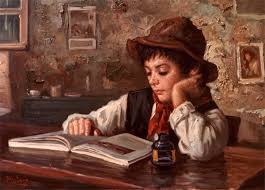
THE SCHOOL BOY by William Blake
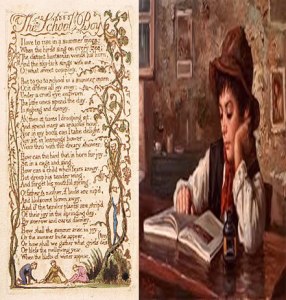
INTRODUCTION
All the stars in the sky shines, but, some shine lesser than others. Everyone is intelligent, but not at the same level. The implication is that nobody is a dullard.
It seems that those who are called dullards are those who were not allowed to explore education in the way that will impact their lives and make the best out of it. It is against this backdrop that William Blake set his pen to duty, using the school as a point of contact to alert the world that the normal classroom education (formal education) does not suit everyone, and that some, if not majority, will do well if they are educated using a different method.
THE POEM
I love to rise in a summer morn,
When the birds sing on every tree;
The distant huntsman winds his horn,
And the skylark sings with me:
O what sweet company!
But to go to school in a summer morn,
O it drives all joy away!
Under a cruel eye outworn,
The little ones spend the day
In sighing and dismay.
Ah then at times I drooping sit,
And spend many an anxious hour;
Nor in my book can I take delight,
Nor sit in learning’s bower,
Worn through with the dreary shower.
How can the bird that is born for joy
Sit in a cage and sing?
How can a child, when fears annoy,
But droop his tender wing,
And forget his youthful spring!
O father and mother if buds are nipped,
And blossoms blown away;
And if the tender plants are stripped
Of their joy in the springing day,
By sorrow and care’s dismay,
How shall the summer arise in joy,
Or the summer fruits appear?
Or how shall we gather what griefs destroy,
Or bless the mellowing year,
When the blasts of winter appear?
ANALYSIS
Let’s get ourselves acquainted with some words used in the poem.
- Summer: it is one of the four seasons in USA and Western world, typically the second, starting from June 22 to September 23. It is the longest and hottest time of the year.
- Morn: Morning, the first section of the day.
- Huntsman: A hunter.
- Winds: To blow air through a wind instrument or horn to make a sound.
- Skylark: A small brown passerine bird that sings while it flies high into the air.
- Cruel: Harsh, not nice, heartless
- Outworn: Worn out and no longer usable.
- Sigh: A deep and prolonged audible respiration of air, when fatigued, frustrated, grieved or relieved. The act of sighing.
- Dismay: Discourage
- Droop: To sink or hang downward. To sag, to lose all enthusiasm or happiness
- Anxious: Being in painful suspense; especially when something unpleasant is about to happen.
- Delight: Joy or pleasure.
- Bower: A woman’s bedroom or private apartment, especially, in the mediaeval castle.
- Dreary: Grievous, cheerless.
- Tender: soft and easy
- Bud: A new formed leaf or flower that has not unfolded.
- Nip: To remove by pinching, biting, or cutting with two meeting edges of anything; to clip.
- Blossom: Of a flower; to start producing fruits
- Strip: To remove; take away
- Mellow: Soft or tender by reason of ripeness. Having tender pulp, a mellow apple.
Bear this in mind as we go through this poem: The poem is more like a manifesto against formal education (classroom education), and since this is coming from a man who almost had no formal education, you should not be surprised.
STANZA ONE
The first stanza opens with an exposition on what appeals to the sense of the poetic persona who assumes to be a little school boy. He likes a natural environment in which everything follows its instinctual order. He speaks of the summer morning when he wakes up to hear the birds singing and the horn sounds of hunters. Such a milieu makes him happy.
“O! What sweet company”
STANZA TWO
Contrarily, to his opinion in the first stanza, the poetic persona informs the reader about what he dislikes.
”But to go to school in a summer morn
O! It drives all joy away”
In the above excerpt, the poetic persona expresses a sad feeling about school. He dislikes going to school in the summer morning, instead, he prefers to stay and enjoy the adventurous environment. He went on to point out that even the students in the classroom get tired by being watched over by a teacher (Cruel eye). Having been demoralized, they sigh and slide into worries.
“Under a cruel eye outworn
The little ones spend the day
In sighing and dismay”
STANZA THREE
Then, given the proceeding stanza, he, the poetic persona, exclaims, “Ah!” that having been discouraged, he would bend down his head and sag (droop) in his chair for a long time.
“Ah! Then at times I drooping sit
And spend many an anxious hour”
He can’t even enjoy reading his book or continue to stay in the class (learning’s bower) because the awful teaching (shower) makes him worn out and tired.
“Nor in my book can I take delight
Nor sit in learning’s bower
Worn thro’ with the dreary shower”
STANZA FOUR
Of course, you may have noticed that the poetic persona opines that learning in a natural environment gives more freedom, relaxation and happiness than learning in a classroom.
In this stanza, he talks about why the classroom schooling is not good. With a sharp metaphorical analogy in which he compares himself to a bird. He says:
“How can a bird that is born for joy
Sit in a cage and sing?”
From the excerpt, one understands that a natural environment for a bird is the air and its nests on the tree branches. So, putting it in a cage limits its happiness and liberty. Metaphorically, the cage is the classroom.
NOTE: The poetic persona has no problem with schooling; his problem is with classroom education.
Nonetheless, it seems that the poetic persona is not aware that most birds are caged and groomed to be better. E.g. – parrots are groomed to talk, Ravens are trained to relay messages etc. This is exactly what the classroom schooling environment does. It grooms our minds and impacts meaningful and useful knowledge.
“How can a child, when fears annoy
But droop his tender wing
And forget his youthful spring”
In the above, the poetic persona talks of youthful exuberance and complains that when he is irritated in the class, instead of showing off his strength in defense of himself, he is made to remain silent and bow down his head on his chair because, he is in the classroom. This simply illustrates the laws in have in schools that prohibits students from fighting or exchanging words. And is the ideology of classroom education which is to move the mind of man barbarism to humanism.
STANZA FIVE
In this stanza, having explained his pain in the stanza four, the poetic persona calls out to his parents, that ( in analogy), if plants are cut off and hindered from growing and being fruitful, the plant will be weaken and would be less productive. In other words, if a human being’s (creature of nature) developmental process is cut off from it natural environment, it will be weakened and probably discouraged to do better.
STANZA SIX
Then, in this final stanza, he goes on to tell the consequences of what is done in stanza five. That having nipped the bud and “blossoms blown away” in the summer, there will be no joy because, there is nothing to eat or enjoy.
“How shall the summer arise in joy
Or the summer’s fruit appear?”
They can’t do anything to restore the joy because, the season of planting has past and winter is here. This stanza says that if the child, during his early age of development, is not given the chance to learn in a natural environment, what then will happen when he comes of age to face the natural environment which he did not grow up in line with. Unfortunately, it is already too late to go back and start learning these ways again.
It is clear that life during school is quite different from life after school. The former teaches and exams while the later exams (after failing or passing) you learn. Hence, the poetic persona is saying, if that is the case, why can’t start earlier to experience life the way it is, so that when it comes to us fully, we will know how to handle it rather than living in an artificial environment and coming out later to face the real environment as a novice.
Indirectly, the poem talks about personal experience, and this personal experience should be made personal by allowing a person to experience his or her life personally rather than being in a classroom, learning with another man’s experience, (teachers teach with their own experience) and come out late to face your our world of experience in a battle field as a novice.
But, this shouldn’t be the case, the problem should be solved by finding out how individuals learn fast and better as well as what the person wants to learn, and then, using that method to teach the person. Classroom education is ok as far as civilization is concern, but, the classroom’s method of impacting knowledge does not suit everyone. This is the cancer in the education system of most countries. Currently, the system is focusing more on science and technology at the expense and death the arts.
Concisely, each individual is naturally something, but there is something the individual would like to be. This should be considered stringently so as to make sure that no scholar/student gets under the “cruel eye” and finds “no delight in learning.”
 Litionary
Great Job. please, I need the themes and poetic devices in The School Boy
LikeLike
I really love this sites.
I appreciate you guys so much for this opportunity.
I’m a jambite and I’ve been looking for analysis that a easy to comprehend. I’ve tried YouTube all to no avail, even bought the (exam focus) worse it makes use of “big big grammar” making it uneasy to comprehend. This is not only comprehensive, it is also short and straight to the point. Thanks alot guys.
LikeLike
Thank you too
LikeLike
Wow, very concise and direct to the point, i really love this work and do feel like not stop saying it each time i go through this work, i it sincerely give a second thought about my attitude each time i read this lessoned work. O! i love it, god bless you sir, legends never dies.
LikeLike